

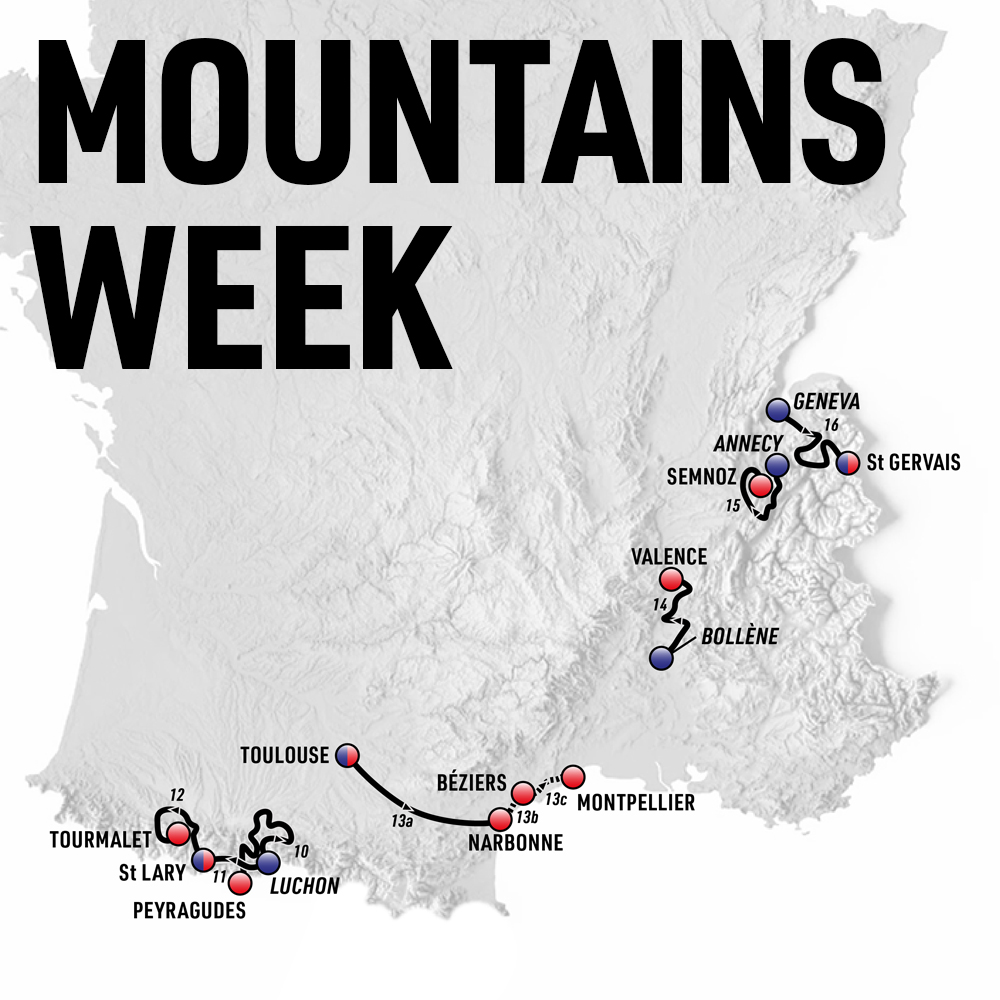
7 days cycling, approx 978km, 20,395m ascent
Pure and simple: 7 of the best possible days on a bike
Overflowing with Tour history, climbs, views, fun, and glory, this Loop gets you 3 outrageously beautiful Pyrenean stages, 2 sparkling Alpine stages and the two brilliant transition stages that join them (including our 1939 homage).
The first of your stages is arguably the toughest; a Pyrenean Loop that takes you over some of the Tour’s most iconic climbs (no transfer tonight as we have 2 nights in the same hotel). Then, from here, our cherry-picked mountain stages are compact in distance, wasting no kilometres and focusing on the climbs that you want. You can choose to test your times on Strava or just settle in for the views and enjoy the challenge, the feedstops and the mountain sun (or a mixture of the two!).
The 1939 and 2025 transition stages ensure that even when you’re not in the mountains, this Loop has a strong Tour feel – and history (ancient and modern) provides the backdrop for our journey east. We zoom past the Canal du Midi and on into Provence, experiencing a completely different feel of fast, flat racing, happy in the knowledge that more mountains are just around the corner…
And those mountains in no way disappoint; both stages start by lakes, both feature gorgeous roads that wind through Alpine villages and both are as atmospheric as you’d expect from a region where often the loudest noise comes from the cowbells. This is mountain cycling at its finest; charming towns, idyllic scenery and a chance to test your climbing legs thanks to some of the Tour’s greatest moments.
Itinerary
Mon 5th July – Travel under own arrangements to our Luchon hotel by 7pm. Meet the team, meet your fellow cyclists, arrival briefing, then dinner
Tues 6th July – Mon 12th July – Cycle stages 10 – 16
Tues 13th July – Depart from our St Gervais hotel – Le Loop transfer to Geneva airport included

Stage 10: Luchon – Peyragudes. 146km / 4212m. Tues 6th July
Year of Stage: 2012
This stage hides some painful efforts in its deceptively short distance. The almost circular route (circular for us because we descend back to our hotel in Luchon at the end) begins with the Col de Menté. It’s a climb steeped in Tour history (21 appearances since the ‘60s), which sets the mood of the day because this is a stage of classics.
A bumpy 60km leads us down from the Menté summit to the Port de Balès which has featured in 6 Tours in the last 20 years: it’s a stunning climb whose brutality is matched by its beauty. To give an idea of how remote and atmospheric it’ll feel as we climb, the road is only open for 5 months a year and until the 1980s there was no road at all. That ‘80s surface wasn’t suitable for anything other than 4x4s and it was the Tour de France itself which instigated paving the road properly in 2006 in order to provide new challenges for its riders.
Our last challenge today is the uphill finish at Peyragudes which is an even more recent addition to the Tour (first appearance on this stage in 2012 and making up for lost time with 5 inclusions since then). It’s a tough finish psychologically because after reaching the Col de Peyresourde, you have to go down to go up (200m down; 240 up) so reaching the end of this stage will be a true landmark of achievement – and you will be treated like the hero you are on your return to Luchon!
Why we chose it: It really did tick all the boxes; for our second mountains stage we wanted short (in kilometres), tough (in elevation), classic (in feel) and the chance to have a third night in our Luchon hotel (3 nights in one place is a rare and ultimate luxury).
Le Loop Logistics
Start: Luchon hotel
Finish: Luchon hotel
Stage 11: Luchon – St Lary. 65km / 3062m. Wed 7th July
Year of Stage: 2018
The unusually short parcours of this stage struck fear into the hearts of the 2018 pro peloton (who had to cover the entire stage at a near-sprint) but we’re able to take this stage at a comfortable pace – a necessary tactic given what’s involved…
It’s a treat in many ways – a pretty perfect cycling day. It’s also the shortest full stage in 35 years at 65km, and more than half of that (38km) will be uphill! The first 46km take us up over the Peyresourde, down through the delightful thermal spa town of Loudenvielle, up the Col de Val Louron-Azet and down into St Lary; all of these being roads we’ve ridden in the other direction over the last couple of days and all with spectacular views.
However, once we get to St Lary (one of our all-time favourite Tour towns), it’s very much new climbing territory and an opportunity to tackle the Pyrenees’ highest ever summit finish, a glorious (!) 17km, av 8.3% climb.
As we pass by our hotel, we look up and see the beginning of the mighty Col de Portet climb winding up out of town to the west (you can’t see to the top until the very last couple of kilometres). The Col de Portet was a brand-new climb when it featured first on this stage in 2018, having been especially paved for the race (previously a dirt track), and was described by Christian Prudhomme at the time as having “all the assets to become a new Tourmalet”. It will feel long (it is long!) but by the time you make it to 2,215m above sea level, with views north and south, you’ll be in the heart of the Pyrenees and will have made it to the Tour of Tours’ second highest point of the Tour (with only the Galibier being higher) and our “Souvenir Henri Desgrange”.
Why we chose it: A few reasons; firstly, the distance – need we say more. Secondly, the Col de Portet for its height, views and proximity to St Lary. Third, St Lary! It’s one of our all-time favourite towns (and hotels!) and we couldn’t leave it out. And lastly, have you ever cycled a stunning route and wondered what it would look like if you could see the views behind you and descend the roads you just climbed (and climb the descents)? We ponder this all the time on Le Loop and thought it would be nice to include a stage (for Grand Loopers who have also ridden stage 9) which offered the answers.
Le Loop Logistics
Start: Luchon hotel
Finish: St Lary hotel
Stage 12: St Lary – Tourmalet. 119km / 3166m. Thurs 8th July
Year of Stage: 1974
Today’s ride is an homage to the 1974 Tour de France, which visited Plymouth for Stage 2, and in which Yorkshireman Barry Hoban won the seventh of his eight stages – a record eventually surpassed by Mark Cavendish, 35 years later in 2009. But the first rider to the Col du Tourmalet was Frenchman Jean-Pierre Danguillaume, closely followed by eternal second Raymond Poulidor.
We’ll be taking the day at a more sedate pace, setting out from scenic Saint-Lary-Soulan for a short roll down the Neste valley, before swinging left and heading up the beautiful Col d’Aspin, a reliable Tour favourite. The views get increasingly dreamy as we ascend its 12km of switchbacks (the gradient is fairly steady, and averages 6.5%), and then we plunge down the other side towards Sainte-Marie-de-Campan, site of one of the Tour’s most enduring legends; Eugène Christophe famously repaired his fork here, at a local blacksmith’s shop, after crashing on the Tourmalet in 1913.
But we’re not going up there just yet. First, we get to enjoy a lovely leisurely roll down the valley, alongside the glittering Adour River. This section may look flat, but in reality, we’ll be losing elevation, meaning that it should feel relatively easy, giving us a chance to watch the scenery change as the landscape opens out, the sky gets bigger, and we move away from the high mountains. After passing through the elegant spa town of Bagnères-de-Bigorre, we encounter a 2km climb (around 4.5%) as we cross the watershed and roll through the foothills, passing verdant farmland and small stone villages as we go.
Skirting the pilgrimage town of Lourdes, we then begin a steady climb up the valley and back into the mountains. This time the false flat isn’t in our favour, and there’s a chance this section may feel harder than it looks, especially in the heat of the afternoon. Once we reach Luz-Saint-Saveur, all that remains is the climb we’ve all been waiting for: 19km at 7.4%, and one of the most iconic cols in Tour history – the mighty Tourmalet.
Why we chose it: Obviously we were going to include the Tourmalet – so the question was just how and when. With this stage, we skip the more standard long haul from Tarbes or Pau and instead have the treat of already being in the mountains. Another very attractive feature is the unusually long (75km) stretch of descent and flat that links the two big climbs of the day; a chance to get your breath back and enjoy the scenery in groups before the big Pyrenean finale-climb. We also chose this as a sibling to stage 19 (see below!)
Le Loop Logistics
Start: St Lary hotel
Finish: Dinner on Tourmalet, followed by transfer to Toulouse hotel
Stage 13: Toulouse – Narbonne/Beziers/Montpellier. A: 148km / 960m, A+B: 175km / 1040m, A+B+C: 245km / 1498m. Fri 9th July
Year of Stage: 1939
We’re actually riding three stages for the price of one today, as back in the 1930s (and in fact up until 1991) it was not uncommon for riders to race a split stage, with two – or sometimes more – races in a single day. It’s unclear how popular this would have been in 1939, but we hope this route will be a hit in 2027, as it showcases what has come to be recognized as classic Tour de France scenery. Expect to see vineyards, fields of sunflowers, and long avenues of plane trees.
Starting with part A, we leave Toulouse on low-lying roads, following close to the Canal du Midi, whizzing through vineyards and past pale stone villages with shuttered windows. This is a region of open rolling countryside and huge skies, although at times we may glimpse the distant Pyrenees on the horizon. The landscape opens out into acre upon acre of vineyards as we skirt the spectacular walled citadel of Carcassonne, and continue along the Aude valley towards Narbonne.
This next section (part B) is part of the ancient Via Heraklea, along which humans have travelled between the Alps and the Atlantic for thousands of years, and some of the buildings we pass date back to Roman times, or even earlier. This should be a relatively swift section; a time trial in 1939 and whilst you’re welcome to time yourself today, it’s also a great chance to chill, enjoy the flat, the chat, and the butter-smooth French tarmac.
Once through Beziers, we’re back into 1939 “normal” racing (part C) and as we near the Mediterranean coast we can taste the salt in the air. Olive groves and sun-drenched stone villas accompany us as we roll exhaustedly into our hotel on the outskirts of Montpellier, looking forward to dinner (as opposed to the cigarettes, brandy, wine and veal that would have greeted the riders on this stage back in 1939!).
Why we chose it: If you didn’t take a first look at this stage and smile, you didn’t look properly! When else will you have the chance to cycle one of those ridiculous stages-of-old, complete with mid stage time trial. It’s as bonkers as it is challenging and lends a sense of incredulous nostalgia to the overall route. Chapeau to anyone who makes it through A, B & C!
Le Loop Logistics
Start: Toulouse hotel
Finish: Montpellier hotel
Stage 14: Bollene – Valence. 160km / 1606m. Sat 10th July
Year of Stage: 2025
Don’t get too complacent about this so-called flat stage because we’re too close to the mountains to avoid a few lumps and bumps, though in many cases we’ll be riding between the hills rather than over them. In 2025 there was enough head-wind to drastically increase the effort output but nonetheless this is a really scenic ride that offers a lot of bang for relatively little buck.
The morning involves a fair bit more up than down but as Valence is only 60m higher in altitude than Bollene, the good news is that the latter half of the day will seem much easier on the legs.
Our morning ride takes us through the arid landscape of northern Provence, with wide views over sweeping vineyards and the occasional burst of yellow gorse. We steadily gain height (over 500m in the first 50km) as we move out of the Rhône valley and into the Baronnies Provençales. This small range of limestone mountains, perched on the edge of the Alps, is known for the wide variety of herbs that are grown and harvested here, so we can inhale the scents of thyme, rosemary and lavender as we make our way through its quiet valleys.
We briefly descend out of the hills for visits to the historic stone villages of Marsanne and Cléon-d’Andran, passing small hamlets and very few cars on the way. And then a scenic climb of around 5km takes us up the rim of the valley, and over the top via a luscious descent to the river Drôme. The rest of this stage will pass quickly as the final hour of the ride is on fast, flat roads, so our arrival in Valence is full of the joys of cycling.
Why we chose it: Plenty of alumni will remember this stage with the biggest of smiles because it was the day that Abdul (one of our 2025 charity visitors) rode with us in style and gave an incredible talk over dinner, reminding us all why we’re here and why we should be so proud of our Le Loop achievements.
We wanted to respect the tradition of including a flatter “sprinter” stage before we hit the Alps and this recent stage was a natural choice. Over the years we’ve spent a fair bit of time in this part of northern Provence, and it never disappoints – this stage had sunflowers, lavender, views, a head wind we might choose to avoid in 2027, and plenty of time for chat… lots to attract us back two years later.
Le Loop Logistics
Start: Transfer to Bollene
Finish: Valence hotel
Stage 15: Annecy Loop. 125km / 3826m OR Annecy TT 42km / 344m. Sun 11th July
Year of Stage: 2013/2009
Back in 2013 this stage was the ride before Paris; at the end of the Alps rather than at the beginning. It was the Etape du Tour stage that year, chosen for its value in metres-vertical per kilometre-hotizontal.
The route starts on the flat bike path by lake Annecy, a lovely chance to stretch our legs and marvel at the holiday views. We continue with a stunning climb through the Mont Revard massif, much of the top section being in the shade of pine trees which make the reveal even more impressive when we pass over the top and suddenly see the shimmering Lac Bourget below us.
Following a descent towards Aix Les Bains with breath-taking views much of the way, the route circles back north and after more than 30km of descent and flat (a chance to get our breath back), we join the Semnoz climb, which to many is the best climb in the area. It’s a delightfully shaded road that gets pretty steep (rarely below 8% in the final kms), before bringing you out by lovely café with views across lake Annecy towards the mountains that are waiting for us.
At ‘only’ 125km long, today is a unique ride packed with special features but one that won’t keep you out until dark!
Optional alternative stage: Instead of the 2013 stage, you can opt instead to do the 2009 Time Trial course which is a delightful 42km with 344m of climbing; a lap of lake Annecy with a small bonus climb half way round.
Why we chose it: location, location, location! Annecy holds a special place in our hearts as several of our Le Loop staff live there and in 2025 we also had a staff weekend cycling round the lake. Coming back for a visit in 2027 was a priority – to enjoy the lake views, the relaxed atmosphere and to give the best ever lite option to those who’d prefer a slightly more holiday vibe to their day.
Le Loop Logistics
Start: Transfer to Annecy
Finish: Transfer to Geneva hotel
Stage 16: Geneva (Annemasse) – St Gervais. 118km / 3025m. Mon 12thJuly
Year of Stage: 1990
We begin our day a stone’s throw from Geneva, in the relative flatlands surrounding Lac Leman, and roll along the Arve valley, watching the mountains appear on the horizon and then gradually close in around us. The countryside is green and calming, overlooked by the occasional limestone crag to remind us of what’s to come. At Cluses we turn right, and begin our ascent of the relentlessly steep Col de la Colombière – the longest climb of the day, at just under 20km. Leaving behind the rural fringes of Cluses, we work our way up through the forests before emerging into Alpine meadows as we pass the serene chalets of Le Reposoir. The col comes into view shortly after this, but there are still several brutal kilometres to go, with a gradient that averages just below 10%.
Look out for the mural of a young Bernard Hinault on the descent to Grand-Bornand – and then we’re straight into the Col des Aravis. This 10km climb is gentler than Colombière, but once again the gradient ramps up in the final kilometres. The wonderful scenery is ample distraction – this is a classic Alpine climb, with smooth tarmac wriggling its way through glowing green pastures, past intricate wooden chalets, with big pointy mountains on the horizon.
Following an exhilarating helter-skelter descent to Flumet, we pass through the ski towns of Praz-sur-Arly and Megève, then soar along the balcony road towards Saint-Gervais, overlooked by Mont Blanc. Our final climb up to Bettex is 7.2km at 7.7%, and steeper towards the top, but our tired legs will be fuelled by a glow of triumph, and the prospect of celebrating a day well spent with our fellow riders.
Why we chose it: While this stage pre-dates Le Loop and the Tour de Force, the climbs within it are old favourites and all of them were high on our shortlist of Alpine wishes. But it’s not all about the cycling… we had a rest day in the same hotel in St Gervais in 2023 and if you weren’t there, take it from us, there’s no more perfect place!
Le Loop Logistics
Start: Geneva hotel
Finish:St Gervais hotel
| Total
Cost |
Deposit | Second Payment
Due end Jan |
Final Payment
Due end Mar |
Fundraising Target | 80% Fundraising
due end April |
|
£2100
|
£250 | £1,010 | £840 | £1,500 | £1,200 |
- Accommodation (Mostly twin share. Single supplements are subject to availability)
- All food (3 meals and the best feedstops you’ve ever seen)
- Fully signed route, the stuff of legend
- Mechanical, medical and moral support
- Luggage Transfers
- Coach transfers to the next stage start when the stages aren’t contiguous
- Travel to and from France (but we’ll give you advice on the best travel routes)
- Bike Transport (£60 each way if you want us to drive your bike there and back (£50 if bought early))
- Evening massage (£15 or €15 per massage if you’d like one – highly recommended)
- Beer/wine/drinks at dinner